
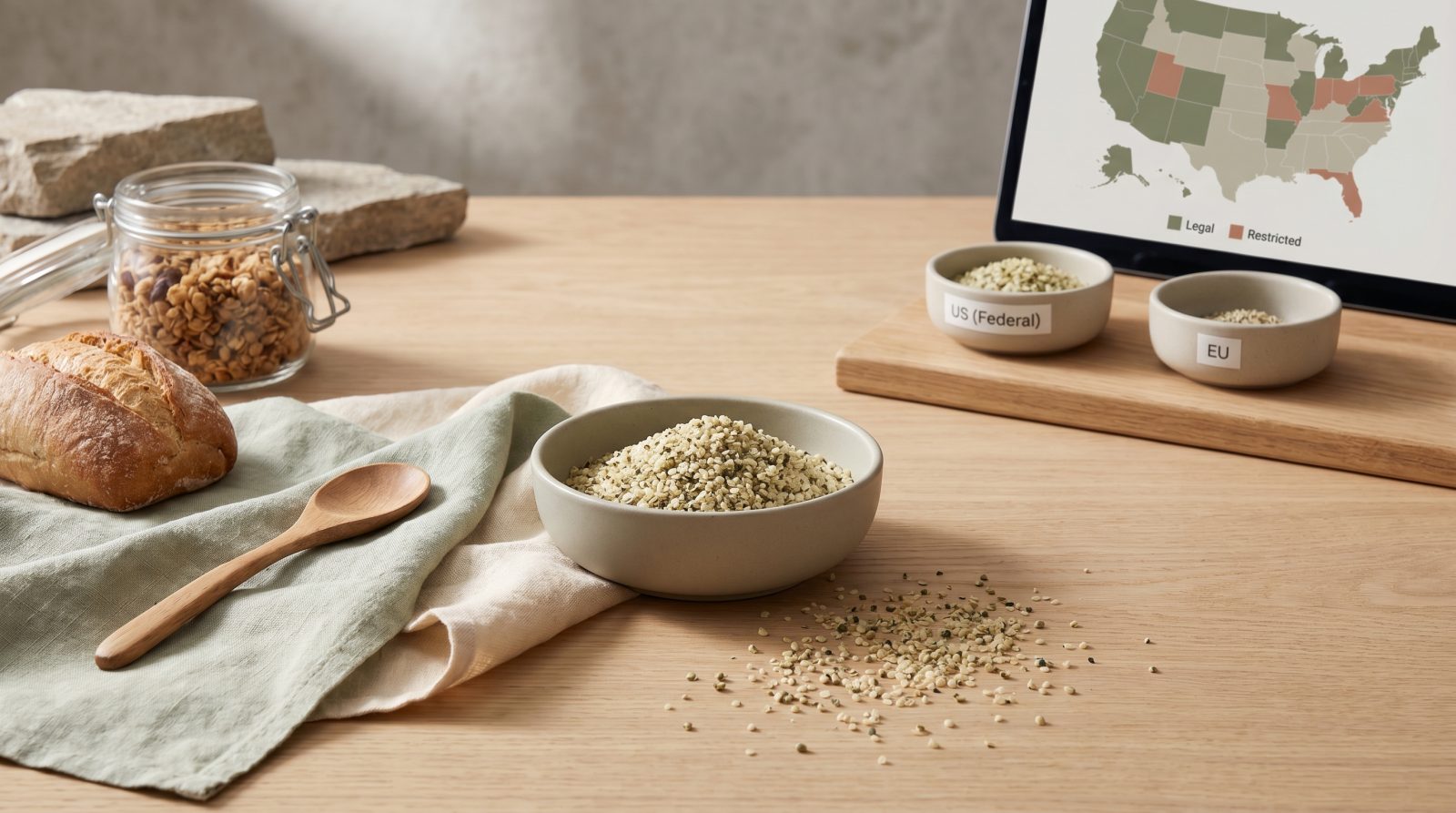
Industrial hemp is legal in most countries that recognise the 0.3 percent THC threshold (or a similar low-THC definition), but the specifics of cultivation licensing, food regulation, and cannabinoid product rules vary substantially. This article summarises the regulatory position in the jurisdictions most relevant to Canadian readers.
Canada
Industrial hemp is legal under the Industrial Hemp Regulations of the Cannabis Act. Cultivation requires a Health Canada licence. Approved cultivars only. Hemp foods are regulated by the CFIA under standard food law. CBD products fall under the Cannabis Act and require separate Health Canada authorisation; retail sale is restricted to provincially authorised cannabis retailers.
Status: cultivation legal under licence; food legal; CBD legal but tightly regulated.
United States
The 2018 Agriculture Improvement Act (Farm Bill) removed hemp (defined as cannabis with 0.3 percent THC or less) from the federal Controlled Substances Act. Federal law now treats industrial hemp as an agricultural commodity. The USDA oversees national-level hemp policy through state plans.
State-level regulation varies widely. Some states have embraced hemp cultivation with minimal additional restrictions. Others (notably Idaho until recently, South Dakota, and several southern states historically) maintained stricter rules. As of 2026, all 50 states have legalised hemp cultivation in some form, though licensing requirements differ.
CBD federal status is murky. The Farm Bill legalised hemp-derived CBD federally, but the FDA has not approved CBD as a food additive or dietary supplement. State enforcement varies. Hemp-derived CBD products are widely sold in many states despite the federal regulatory ambiguity.
Status: cultivation legal federally; state rules vary; CBD federally permitted but FDA-restricted.
European Union
EU policy treats hemp as an agricultural crop. The Common Agricultural Policy supports hemp cultivation with subsidies similar to other crops. In 2023, the EU raised the THC threshold for industrial hemp from 0.2 percent to 0.3 percent, aligning with the North American standard.
Hemp foods are legal in most EU member states under the Novel Foods Regulation. Hemp seed, hemp oil, and hemp protein have a long history of food use in Europe and are generally permitted without novel-food authorisation.
CBD is treated as a novel food in the EU; products require Novel Foods authorisation, a slow and rare process. Several member states have parallel national regulations that affect CBD market access. Member state CBD enforcement varies; in some markets CBD is sold widely, in others restrictively.
Status: cultivation legal; food legal; CBD regulated as novel food, market access varies by member state.
United Kingdom
The UK requires a licence from the Home Office for industrial hemp cultivation. The 0.2 percent THC threshold was retained after Brexit, narrower than the EU's revised 0.3 percent.
Hemp seed foods are legal but UK regulations have historically been restrictive. CBD is treated as a novel food, requiring authorisation. The Food Standards Agency operates a list of CBD products with valid novel food applications; products not on the list are subject to enforcement action.
Status: cultivation legal under licence; food legal; CBD regulated as novel food.
Australia and New Zealand
Australia and New Zealand legalised hemp foods in 2017 through Food Standards Australia New Zealand (FSANZ) approval. Hemp seed, hemp oil, and hemp protein are sold openly in supermarkets in both countries. Cultivation requires state-level licensing in Australia and a national licence in New Zealand.
CBD was rescheduled in Australia in 2021 to allow over-the-counter sale of low-dose CBD products through pharmacies, but rollout has been slow due to required Therapeutic Goods Administration product registration. New Zealand permits prescription CBD only.
Status: cultivation legal under licence; food legal; CBD highly restricted.
China
China is the world's largest hemp producer by acreage, primarily for textile fibre and traditional medicine use. Industrial hemp cultivation is permitted under provincial licensing in Heilongjiang and Yunnan provinces. Hemp food production and trade are growing but remain a small share of total Chinese hemp output.
CBD extraction is prohibited for domestic consumption but permitted for export, creating an unusual regulatory split. Cosmetic CBD use was banned in 2021.
Status: cultivation legal in approved provinces; food legal; CBD restricted for domestic use.
Russia and Eastern Europe
Russia, Ukraine (pre-2022), and Romania historically maintained hemp cultivation through the 20th century even when Western countries did not. Russian hemp acreage has grown since 2010 supported by federal subsidies. Eastern European production primarily supplies the European fibre market.
The pattern
Three regulatory archetypes recur across jurisdictions:
- Hemp food and fibre: generally permitted. Most countries with any regulatory framework allow hemp food and fibre under licence.
- Cultivation: licensed. The 0.3 percent THC threshold (0.2 percent in some jurisdictions) is the standard. Approved cultivars and grower licensing are typical.
- CBD: variable and often restrictive. The cannabinoid market is the friction point. Even in jurisdictions with liberal hemp food regulations, CBD often requires separate, more restrictive authorisation.
For travellers, the safest assumption is that hemp foods purchased in a regulated retail environment are permitted in most destinations, while CBD products are subject to local rules that vary significantly and may carry meaningful legal consequences in some jurisdictions.
Regulatory information current as of mid-2026. Laws change. For commercial activity, consult current official sources and qualified legal counsel in the relevant jurisdiction.
Sources and further reading
- Health Canada: Producing and selling hemp.
- Health Canada: Hemp and the hemp industry FAQ.
- Canadian Food Inspection Agency for food labelling requirements.
This is general information, not legal advice. Consult the primary sources or a qualified professional for your situation.