
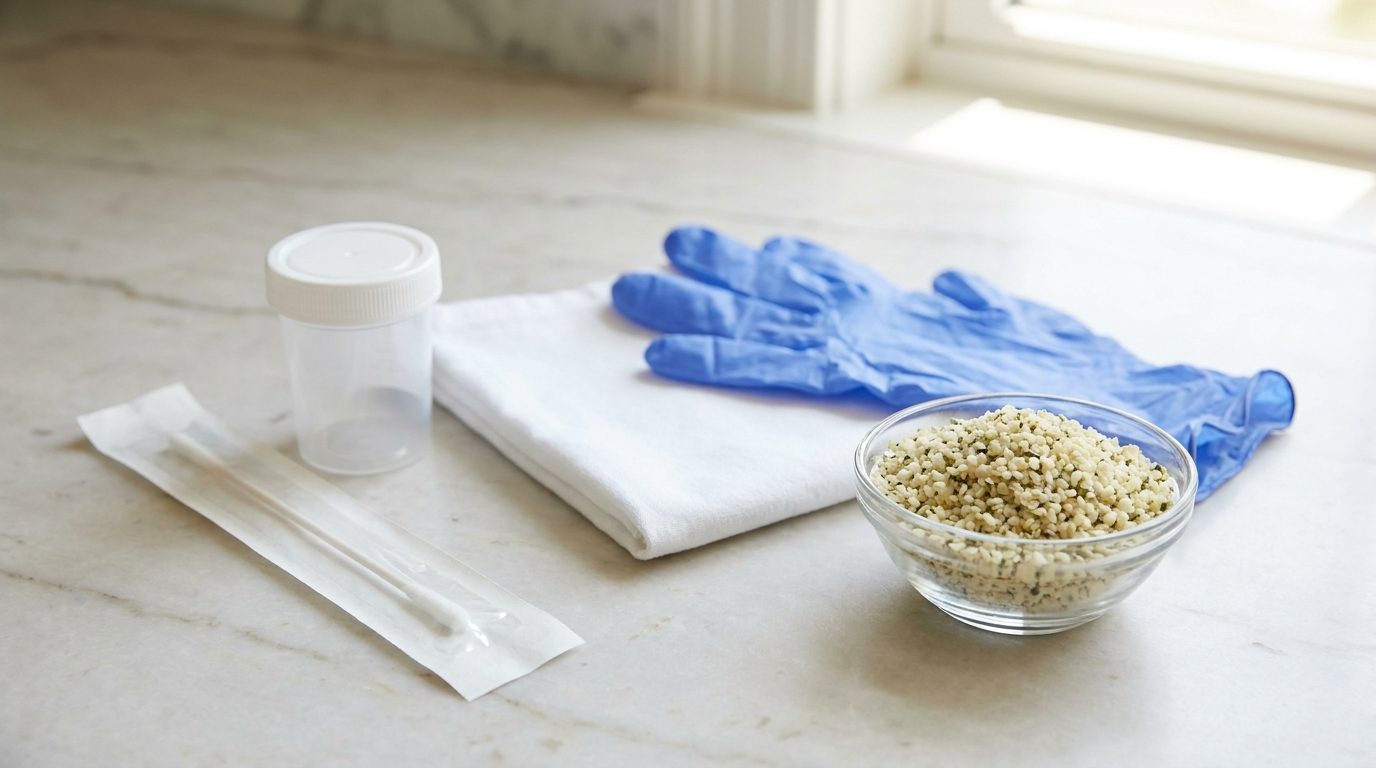
The short answer most readers want: eating normal amounts of hemp food is very unlikely to cause a failed workplace drug test. The longer answer involves trace THC, screening thresholds, and a few situations that deserve genuine caution.
Why the question exists
Hemp foods can contain trace THC, picked up from contact with the plant's resin during harvest and processing. The amounts are typically tiny, but they are not always zero, and standard drug screens look for THC metabolites. Canada no longer sets a THC limit for hemp seed foods: the former limit of 10 micrograms per gram was removed in March 2025.
What testing actually measures
Workplace urine screens flag THC metabolites above a cutoff, commonly 50 nanograms per millilitre on the initial immunoassay. In the best-known controlled study (Leson and colleagues, 2001), 15 adults took hemp oil supplying up to 0.45 mg of THC a day in 10-day periods, and three of them 0.6 mg. At the common 50 nanogram per millilitre cut-off, no sample screened positive up to 0.45 mg and one did at 0.6 mg, though some screened positive at a stricter 20 ng/mL cut-off. No sample reached the 15 ng/mL cut-off used to confirm a positive; the highest was 5.2 ng/mL. The authors equated 0.6 mg a day with about 300 g of hulled hemp seed at the THC level then typical of Canadian products, far more than anyone eats as food.
Where caution is legitimate
- Very large intakes. In that study the only positive screen at the 50 ng/mL cut-off came at the highest dose, which the authors equated with about 125 mL of hemp oil a day.
- Poorly cleaned products. THC on hemp seed comes mainly from resin on the hull, so cleaning and hulling decide how much remains, and earlier studies found that some hemp foods could cause positive results. With no Canadian THC limit for hemp seed foods since 2025, a brand that tests each lot and shares the results is the safeguard; mystery imports may not test at all.
- Zero-tolerance regimes. Some employers and sport bodies use lower cutoffs or test blood. Athletes under anti-doping rules should review their federation's position rather than rely on general workplace guidance.
- CBD products. Full-spectrum CBD contains more THC than hemp food and is the more common cause of unexpected positives. That is a CBD issue, not a hemp food issue.
The practical rules
Buy recognized brands from regular retail, keep intake in the realm of food rather than megadosing, and if your livelihood depends on a zero-tolerance test, discuss it with the tester rather than guessing. For the related but different question of CBD, see the distinction that matters.