
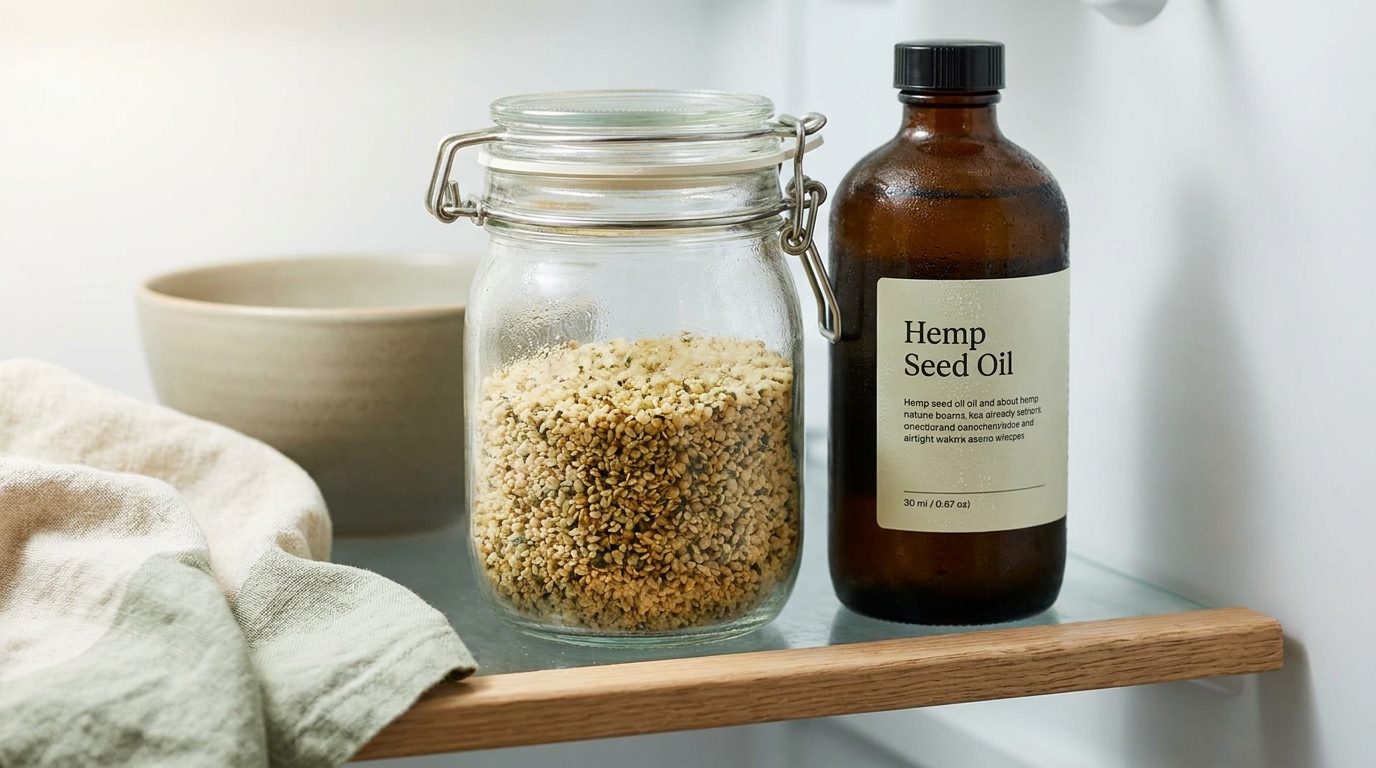
Hemp seeds do go bad, but slowly and predictably. That sharp, bitter, faintly fishy taste in a spoonful of hemp hearts is the flavour of oxidation, and once it arrives there is no rescuing the batch. Kept sealed, cold and dark, an opened bag stays fresh for months rather than weeks. This guide explains what is breaking down inside the seed, how long each form lasts in the cupboard, fridge and freezer, and how to tell when a batch has turned.
Do hemp seeds go bad?
Yes. Hemp seeds go bad by turning rancid rather than by rotting: the oil inside them slowly reacts with oxygen and develops a bitter, paint-like or fishy taste. Most bags carry a best-before date rather than an expiry date, commonly set about 12 months from packing, and a sealed bag of hemp hearts keeps to that date; once the bag is opened, plan on about 4 to 6 weeks in a cool cupboard or 3 to 6 months in the fridge.
The reason is the fat. Roughly three-quarters of the fat in a hemp seed is polyunsaturated, and a meaningful share of that is alpha-linolenic acid, the plant omega-3. The chemical structure that makes omega-3 and omega-6 fats nutritionally valuable, those multiple double bonds in the fatty-acid chain, is also the structure that oxygen attacks most easily.
When those double bonds react with oxygen, the fat begins to break down into smaller compounds, some of which carry strong, unpleasant flavours and odours. This process, lipid oxidation, is what we taste and smell as rancidity. It is not spoilage in the microbial sense; the seeds are not rotting or growing anything. They are slowly going stale at the molecular level, whether or not anything is living on them.
Three things speed the reaction up: oxygen, heat and light. Moisture and trace metals can accelerate it further. This is why a bag left open on a warm, sunny counter turns far faster than the same bag sealed and chilled. Everything in the storage advice below is a way of starving the reaction of one or more of those accelerants.
Why hearts turn faster than whole seed
Whole hemp seed wears a thin shell, and that shell is a genuine barrier. It limits how much oxygen reaches the oil-rich interior, so intact whole seed is the most shelf-stable form. Hemp hearts, the shelled kernels of the seed, have lost that protection. Every heart is an exposed surface of delicate oil, which is why hearts oxidize noticeably faster than whole seed kept under the same conditions. The buyer's map of hemp seed, hearts, oil and protein explains how each form is made.
Hemp seed oil sits at the far end of the spectrum. Pressing the seed concentrates the fragile fat and exposes all of it to air at once, so oil has the shortest practical life of any hemp product and benefits most from refrigeration. Hemp protein powder lands somewhere in the middle: much of the oil has been pressed out to make it, so it is more stable than hearts, but it still contains residual fat that can eventually turn, and its large surface area of fine powder gives oxygen plenty to work with.
Do hemp hearts need to be refrigerated after opening?
Yes. Once the bag is open, the fridge is the best place for hemp hearts: cold slows the oxidation that makes them rancid, stretching an opened bag from about 4 to 6 weeks in a cupboard to about 3 to 6 months. An unopened bag does not need refrigerating; a cool, dark cupboard is fine until the best-before date.
Producers' labels differ on how strict to be. Many say plainly to refrigerate after opening; others treat the fridge as optional but note that it extends freshness. Both point the same way. Hemp hearts left at room temperature after opening do go bad sooner: the same oxidation happens, only faster, and a warm kitchen speeds it further. The more of a bag you have left, the more refrigeration matters.
Hemp seed oil is the form where refrigeration after opening is close to universal advice: producers typically say to keep an opened bottle in the fridge and use it within about 3 to 8 weeks. Whole seed is the most forgiving, because its shell shields the oil inside. Health Canada recommends keeping a fridge at 4°C or colder; keep hemp on a shelf rather than in the door, which is the warmest part of most fridges and the one whose temperature swings most.
How long are hemp hearts good for after opening?
About 3 to 6 months in the fridge in an airtight container, and about a year in the freezer; at room temperature, an opened bag is best used within about 4 to 6 weeks. These are general freshness windows rather than safety limits. Producers' own advice varies: one asks you to use an opened pack within four weeks, another to eat it within three months of opening and keep it in the fridge, while a third gives a shelf life of at least 12 months from manufacture and says an airtight container in the fridge extends it. The table sets out the figures for every common hemp form.
| Form | Cool, dark cupboard | Refrigerator | Freezer |
|---|---|---|---|
| Hemp hearts (shelled) | Sealed: to the best-before date, commonly about 12 months from packing. Opened: about 4 to 6 weeks | Opened: about 3 to 6 months | About a year from freezing, often longer |
| Whole hemp seed | Sealed: to the best-before date; the most stable form | Keeps longer than hearts; follow the best-before date | Keeps longer than hearts; seal airtight |
| Hemp seed oil | Unopened: to the best-before date. Not recommended once opened | Opened: about 3 to 8 weeks; follow the label | Can extend life; expect some texture change |
| Hemp protein powder | Sealed: to the best-before date. Opened: keeps in a cool, dry place if kept dry | Optional; extends freshness after opening | Optional for long storage |
Always defer to the best-before date and any storage instruction on the package, which reflect the producer's own testing. A best-before date describes an unopened package stored as directed. Once you break the seal, fresh air gets in at every opening and the clock speeds up regardless of which form you have, so treat an opened package as having a shorter life than a sealed one.
Can you freeze hemp hearts and hemp seeds?
Yes. Freezing is the most effective way to keep hemp hearts and seeds: sealed airtight at -18°C, they keep about a year, often longer, and you can use them straight from frozen. Cold dramatically slows the oxidation reaction, and because hemp seeds and powder are dry, they need no thawing time; a spoonful stirred into a smoothie, oatmeal or yogurt is ready at once.
- Freeze in portions. Split a large bag into smaller sealed containers or freezer bags, press out the air, and label each with the date, so you only open what you need.
- Keep trips out of the freezer short. Scoop what you need and return the container promptly, so moisture does not condense on the cold seeds.
How do you store hemp hearts after opening?
Seal them airtight and keep them in the fridge, and freeze whatever you will not finish within a few months. The principles are the same for every hemp form; only the urgency changes. Keep air, heat and light away from the fat.
- Choose an airtight container. Transfer from a flimsy bag into a sealable jar or a tight clip-lock container, or at minimum press the air out and seal the original bag well. The less headspace of trapped air, the better.
- Refrigerate hearts and oil after opening. These are the two most fragile forms. For hearts you buy in volume, freeze the bulk the day you open it and keep only a small working jar in the fridge.
- Keep oil in the dark. Good hemp seed oil is usually bottled in dark or opaque glass for a reason. Store it upright on a fridge shelf, capped tightly between uses, and never leave it next to the stove.
- Keep protein powder bone dry. Moisture is the enemy for powders. Use a dry scoop every time, reseal promptly, and keep it away from steam and the kettle.
- Buy at a pace you can use. The cheapest insurance against rancidity is not over-buying. A smaller bag finished quickly beats a value-size sack that turns before you reach the bottom.
You cannot reverse oxidation that has already happened, but you can slow what is left. Squeeze excess air out of resealable bags before closing them, and keep everything well away from the stove, the dishwasher's steam and any sunny windowsill.
How can you tell if hemp hearts are bad?
Smell and taste a few: fresh hemp hearts are mild, green and nutty, while rancid ones taste sharply bitter and smell like old nuts, oil paint or fish. Your nose and tongue are reliable here, because rancid fat announces itself clearly; fresh hemp oil tastes grassy and nutty.
- Hearts and whole seed: pronounced bitterness is the giveaway; truly fresh seed should not taste bitter.
- Hemp seed oil: a harsh, bitter or fishy taste instead of the grassy nuttiness; a flat or chemical smell. Oil is where rancidity is easiest to detect because the fat is concentrated.
- Hemp protein: a bitter or sour-bitter edge layered over the normal earthy, slightly grassy flavour, sometimes with a stale smell on opening.
Rancidity is different from mould. Rancid hemp is oxidized fat, a quality problem that makes the seeds unpleasant to eat. Visible mould, fuzzy growth, damp clumps, off colours or a musty smell point to moisture and possible spoilage, and anything showing those signs should be discarded outright. Smell and taste can tell you that hemp has gone rancid, but they cannot tell you that a food is safe: Health Canada advises against using your senses to judge food safety, and to throw out anything you are unsure about.
What happens if you eat expired hemp seeds?
Usually nothing, if they were kept sealed, cool and dry: a best-before date marks the end of peak quality for an unopened package, not a safety cut-off, and Health Canada says food can be eaten after it, though it may have lost some freshness, flavour and nutritional value.
Seeds that have turned rancid are a different matter. If they taste bitter or paint-like, their omega-3 and omega-6 fats have already begun to break down and there is nothing to gain from eating them; throw them out. Discard at once any seeds showing mould, damp clumps, insects or a musty smell, whatever the date on the bag.
The habit that prevents rancidity
The simplest habit that prevents almost all hemp rancidity is this: treat hemp seeds and oil like the perishable, fat-rich foods they are, not like a dry pantry staple. Buy what you will use in a reasonable window, get hearts and oil into the cold as soon as the seal is broken, freeze any surplus the same day, and taste a few seeds before you commit a whole spoonful to a recipe. Do that, and the bitter, fishy off-flavour never has a chance to develop.
If you would like to go deeper on choosing fresh product in the first place, or on how the omega-3 and omega-6 content actually breaks down, the article index collects the related guides in one place.