
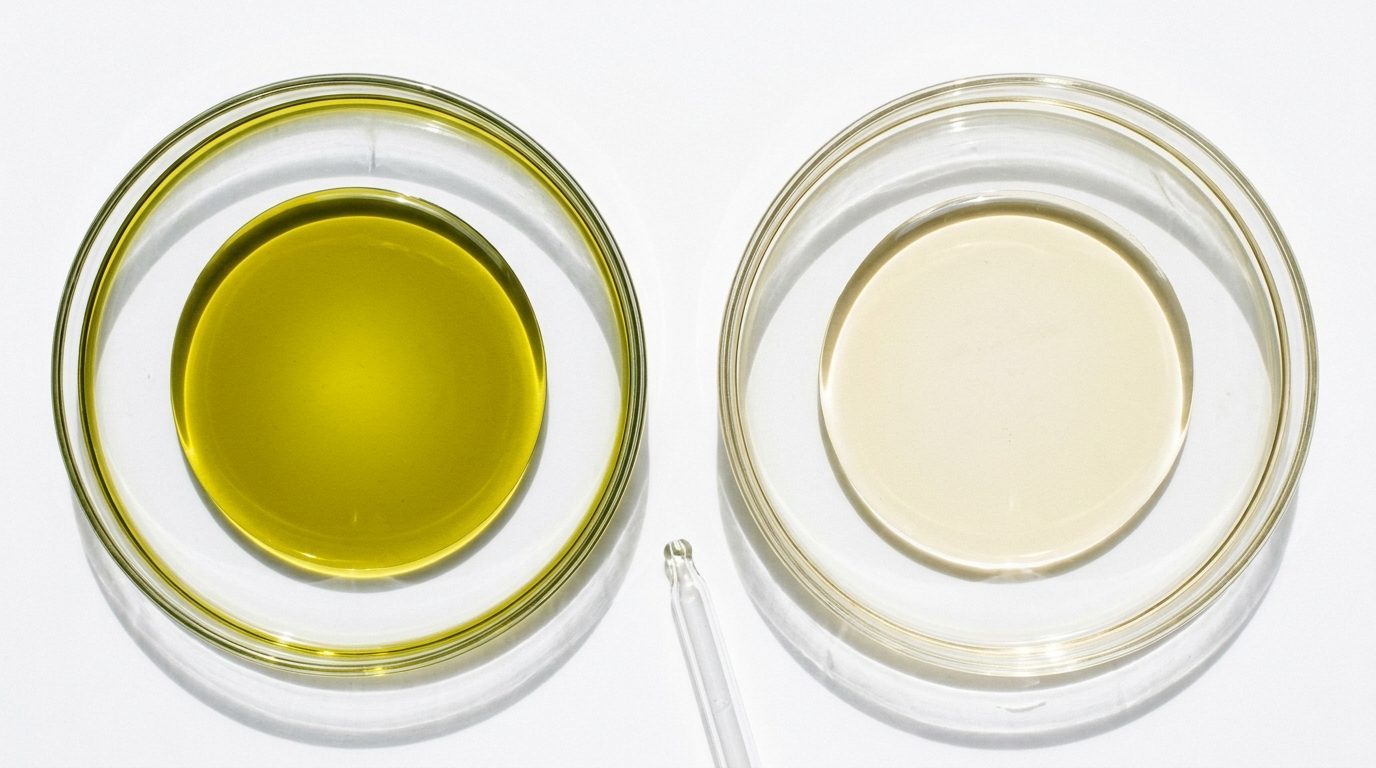
Two bottles of hemp seed oil can look like entirely different products — one deep green and grassy, one pale gold and nearly flavourless — and both can be honestly labelled. The difference is what happened after the press.
How the oil gets out of the seed
Food-grade hemp seed oil is almost always pressed mechanically. Whole or hulled seed is fed into a screw (expeller) press that squeezes oil out under pressure, leaving a dense residual cake behind — the same cake that gets milled into hemp protein powder and hemp flour. Hemp seed is roughly a third oil by weight, so both streams have real commercial value; the press is not a waste process.
Pressing generates heat through friction whether the operator wants it or not. How much heat, whether the press head is cooled, and whether the seed is warmed beforehand to raise yield: that is the first fork in the road, and everything downstream follows from it.
What "cold-pressed" means, and what it doesn't
Cold-pressed has no single universal legal definition for hemp oil the way certain olive oil grades do. In practice it signals that the producer held press temperatures low — figures in the low to mid double digits Celsius are commonly cited — and did not pre-cook the seed. Lower temperature means lower yield per tonne, which is a large part of why cold-pressed oil costs more.
What it does not mean: that the oil never got warm, that it is unfiltered, or that it is automatically fresher. A cold-pressed oil pressed a year ago and stored on a bright shelf is in worse condition than a carefully handled, slightly warmer-pressed oil from last month. If the claim matters to you, ask the producer what temperature they hold and when the lot was pressed.
Filtering, settling and winterizing
Oil straight off the press carries fine seed particles, waxes and phospholipids. Most producers let it settle and then filter it. This is the lightest form of processing and changes essentially nothing about the fat itself.
It matters more than it sounds. Suspended solids make the oil cloudy and shorten its life, because particulate matter and residual moisture accelerate the oxidation that turns hemp oil bitter. A well-filtered oil in a dark bottle beats a romantically murky one in clear glass almost every time. Winterizing — chilling the oil so waxes crystallise out, then filtering again — goes a step further and is more common in oil destined for cosmetics, where cloudiness at room temperature reads as a defect.
What refining removes
Full refining is an industrial sequence: degumming, neutralising free fatty acids, bleaching with adsorbent clays, and deodorising with steam under heat and vacuum. Each step strips something out.
- Colour. Chlorophyll and carotenoids come out, taking the green with them. Refined hemp oil runs pale yellow to nearly clear.
- Flavour and aroma. The grassy, nutty character is a deodorising target, not a bonus.
- Minor components. Some tocopherols, phytosterols and waxes are lost along the way — including antioxidants that were protecting the oil inside the bottle.
- Free fatty acids and off-notes, which is exactly the goal when the incoming oil is headed for soap, cosmetics or a neutral-tasting blend.
What refining largely does not change is the fatty acid ratio. Refined hemp oil is still a predominantly polyunsaturated oil, which means it is still a poor frying medium. Neutral flavour is not heat tolerance — those are separate properties, and confusing them ruins both the oil and the dish.
Which oil for which job
| Use | Choose | Why |
|---|---|---|
| Dressings, dips, finishing drizzle | Unrefined, cold-pressed | The colour and grassy flavour are the product |
| Smoothies, yogurt, cold sauces | Unrefined or lightly filtered | Flavour is buffered by other ingredients |
| Baking where hemp flavour would clash | Refined | Neutral taste; keep the oven moderate and treat it as fat, not flavour |
| Balms, soaps, skincare formulation | Refined or winterized | Colour and odour stability matter on skin and in packaging |
| Frying or searing | Neither | Both are polyunsaturated; use a heat-stable oil instead |
Telling the bottles apart before you buy
- Packaging. Dark glass or tin is a sign the producer expects the oil to be sold as unrefined and cares about light exposure.
- Where it sits in the store. A refrigerated case suggests unrefined culinary oil; a warm shelf beside neutral cooking oils suggests refined.
- Label vocabulary. Unrefined, virgin, cold-pressed and filtered describe minimal processing. Refined, deodorised, bleached and cosmetic grade describe the other path.
- A date. A pressing or harvest date, or a lot code you can ask about, is worth more than any adjective on the front label.
If you want to see how hemp oil relates to the rest of the seed's product family — hearts, protein, flour, cake — the article library maps it out.
The practical rule: buy unrefined cold-pressed oil in the smallest dark container you will actually finish within about eight to twelve weeks, keep it in the fridge, and taste it the day you open it so you know what fresh smells like. Reserve refined oil for the two jobs it genuinely does better — neutral-flavoured baking and topical formulation. If an oil tastes sharp, waxy or faintly like old paint, it has oxidised; no amount of vinegar or garlic in the dressing will hide it, and the fatty acids you paid a premium for are exactly the part that degraded.