
In early 2025 Canada quietly did something significant for hemp food, and almost nobody outside the trade noticed. It removed the licensing requirement for a whole class of hemp products. It also drew a line — and the line it drew is the reason a small producer still cannot make food from hemp sprouts.
I argued for sprouts at the Ottawa consultation on the original Industrial Hemp Regulations in early 1998. I lost. Twenty-eight years later the rules are being rewritten again, and the argument has become both simpler and stronger, because the government has now conceded most of the principle without following it to its conclusion.
What actually changed in 2025
The instrument is SOR/2025-43, registered on 26 February 2025 and published in the Canada Gazette, Part II on 12 March. Its title is Regulations Amending Certain Regulations Concerning Cannabis (Streamlining of Requirements), which is not a title designed to attract attention. A companion order registered the same day, SOR/2025-44, made the change to Schedule 2 of the Cannabis Act described below.
What it did, in plain terms:
- Removed the 10 ppm THC concentration limit on hemp grain derivatives.
- Removed testing and labelling requirements for wholesale sales of those derivatives.
- Removed import and export permit requirements for them.
- Allowed derivatives of Schedule 2 plant parts to be processed, imported, exported and sold without a licence at all.
Schedule 2 of the Cannabis Act is the list of things that are legally not cannabis: a non-viable seed, a mature stalk without leaf, flower, seed or branch, fibre from that stalk, and the root. The 2025 reform took that list and said, in effect, that anything you can make from those things is nobody's regulatory business. The Gazette puts it about as bluntly as regulators do: processing technologies "can be used without a licence under the Act on hemp roots and devitalized hemp grain, for all purposes."
That is a genuinely good piece of policy. It is the reason hemp hearts, hemp protein, hemp flour and cold-pressed hemp oil can now be produced by a food company that holds no cannabis licence of any kind. It is exactly the risk-proportionate approach the industry spent two decades asking for.
The line it drew
Every item on that list has something in common. A non-viable seed cannot grow. A mature stalk stripped of its leaves and flowers cannot grow. Fibre cannot grow. A root, severed, cannot grow.
The reform deregulated dead material. Viable hemp seed — seed that can still germinate — stayed exactly where it was, on the licensed side.
You can see why. Viable seed can become a plant, a plant can be diverted, and the whole architecture of the Cannabis Act is built around controlling the living plant. As a general principle it is defensible.
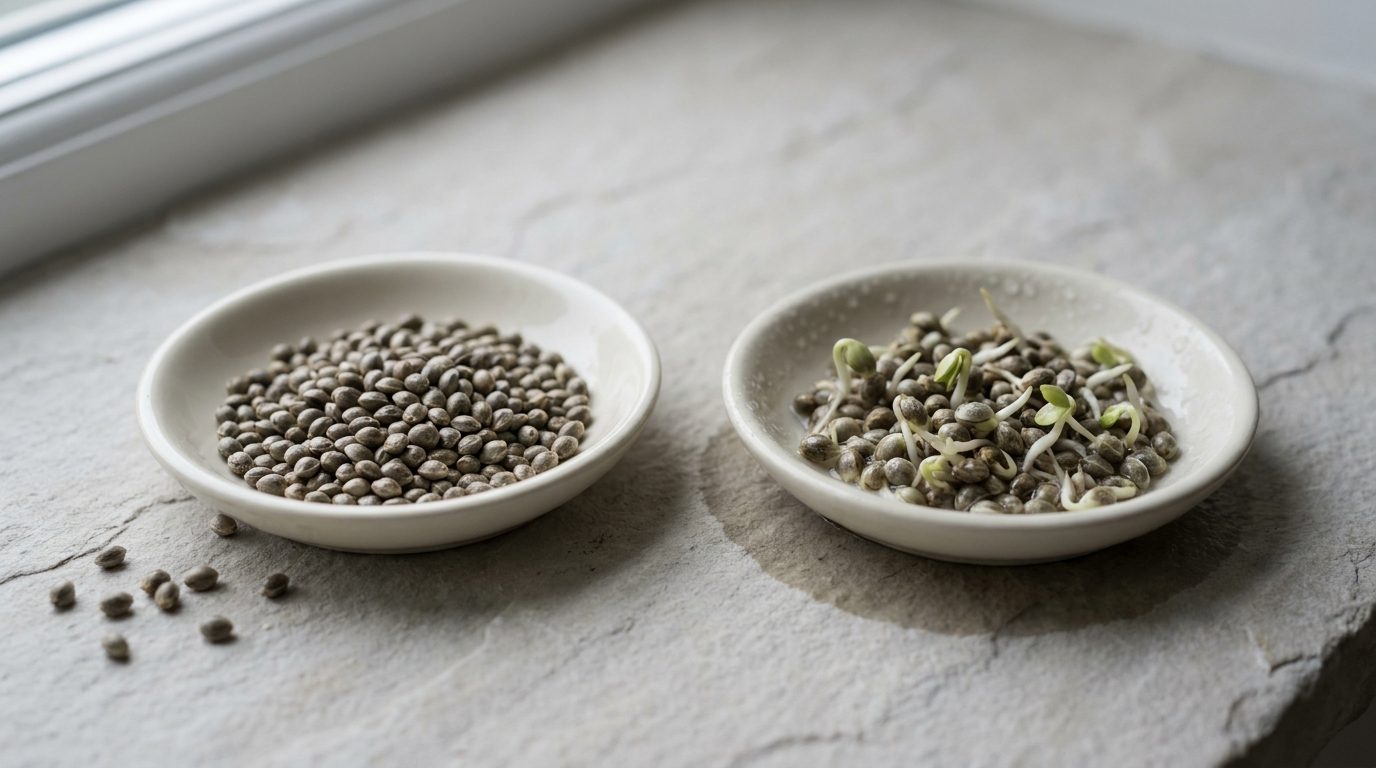
But it has one consequence nobody appears to have considered. Sprouting is the only hemp food process that requires the seed to be alive. Everything else in hemp food — hulling, pressing, milling, roasting — works on a seed that is dead or can be devitalised first. Sprouting cannot. A sprout is, definitionally, a germinated seed. If the seed is non-viable, there is no sprout.
So the 2025 reform freed every hemp food process except the one that needs a living seed. Not by decision. By drawing a line in a sensible place and not noticing what was standing on the far side of it.
Where sprouts sit now
I want to be careful here, because I got this wrong myself in an earlier version of my own account and would rather correct it than repeat it.
The 1998 regulations, SOR/98-156, banned sprouts in terms — the prohibition on whole plants said "including sprouts", and the derivative provisions carried it through. That instrument was repealed on 17 October 2018, when hemp moved under the Cannabis Act. The regulations in force today are SOR/2018-145, and the word "sprout" does not appear anywhere in them.
So there is no longer an explicit ban. What there is instead is the viability line. A sprout requires viable seed; viable seed is not in Schedule 2; anything not in Schedule 2 is cannabis; and cultivating cannabis requires a licence. The prohibition survived the repeal of the sentence that created it, as a consequence of definitions rather than an act of policy.
That reading is mine, reasoning from the provisions rather than quoting a rule that says so. If Health Canada takes a different view of where a germinated hemp seed falls, I would genuinely like to hear it — because at the moment nobody in the food business can tell you with confidence, and that uncertainty is itself the problem.
Why the risk argument does not hold
The case for controlling viable seed is diversion: seed becomes plants, plants become a supply the state cannot see.
A sprouting operation does not look like that. Sprouts are harvested in days, not months. They never flower, and cannabinoids in hemp concentrate in the flowering heads and leaves of a mature plant — which is why the industrial hemp threshold in SOR/2018-145 is measured there. A hemp seed germinated in a tray for four days has no more THC in it than the seed did, and the seed is legal to eat.
Whatever a four-day-old hemp sprout is, it is not a diversion risk. It is a salad.
Why it matters commercially
This is the argument I made in 1998 and it has not changed.
Soy's great commercial advantage as a protein crop is that it swells when soaked. A dry bean becomes several times its volume, and that single physical property underwrites an enormous range of products — tofu, tempeh, soy milk, textured protein. Hemp does not do this. A hemp seed soaked in water is a hemp seed that is slightly wet.
Sprouting is the one process that gives hemp the same transformation. A sprouted seed changes in volume, in texture and in what can be built from it. Take sprouting off the table and hemp food is permanently confined to seed, oil and flour — which, twenty-eight years on, is precisely where it is.
Why this is a small-producer question
The 2025 reform matters most to people without lawyers. A licence is not merely a fee; it is an application, a security clearance, a site, record-keeping and reporting. A national processor absorbs that as a line item. For someone selling at markets, it is the whole business.
That is why the effect of the viability line falls almost entirely on small operators. A large licensed processor that wanted to make sprout products could do so tomorrow. The person who cannot is the one with an idea, a room and no licence — the same person who used to put twenty different hemp foods on Canadian shelves and now does not.
Twenty years ago there were roughly ten times the number of hemp food products in this country that there are today. That collapse was not caused by the regulations. But it was not prevented by them either, and rules that are trivial for a large company and prohibitive for a small one are not neutral between them.
Why now
Health Canada published a Notice of Intent in the Canada Gazette, Part I on 16 May 2026 and ran a 45-day comment period that closed on 30 June. A formal proposal is expected in the Gazette around spring 2027, with a further comment period then.
It would be easy to read that as meaning the moment has passed and the next one has not arrived. I think the opposite is true. The comment period is where positions are collected; the months afterwards are where the proposal is actually drafted. What appears in the Gazette next year is being decided now. Arguing after publication means asking officials to reopen something they have already written.
The stated purpose of this review is to reduce regulatory burden where the risks do not justify it. The 2025 amendments already accepted that principle for everything made from a dead hemp seed. Extending it to a seed that is four days into germinating is not a new principle. It is the same one, applied to the case that was missed.
I would also, twenty-eight years later, still like to be able to make food from sprouts.
Eric Hughes has worked in hemp since 1996, when he incorporated his first company and began making food from hemp seed — two years before hemp cultivation became legal in Canada. He founded Chi Hemp Industries in Victoria in 1998 and ran it until 2014, created the Zima Crisp hemp-seed bar, served as president of the BC Industrial Hemp Growers' Association, and built the Canadian Hemp Trade Alliance's first website in 2003. Regulatory citations above were checked against the published instruments in August 2026; the conclusion about where sprouting falls is his own reading of how those provisions fit together.